Scriptcase und tinyMCE mit benutzerdefinierten init Parametern
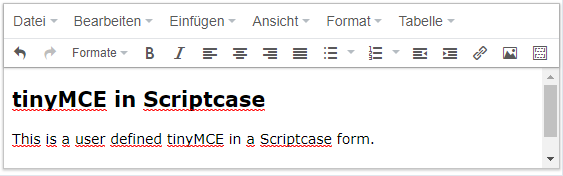
tinyMCE in Scriptcase mit beliebigen init-Einstellungen aufrufen
tinyMCE ist ein HTML-Editor, der in eigene Programme eingebunden werden kann.
Scriptcase verwendet ihn standardmäßig zum Anzeigen und Editieren von Text/BLOB-Feldern mit HTML-Formatierung.
Dabei kann man zahlreiche Parameter einstellen, aber nicht alle und vor allem keine Plugins dazu laden.
Natürlich könnte man tinyMCE selbst nochmals einbinden und dabei die init-Prozedur variabel aufrufen.
Dann muss man auch beim Veröffentlichen (deploy) der Anwendung auf den Live-Server diese Installation manuell vornehmen.
Einfacher geht es, wenn man in der Scriptcase Form ein Text-Feld mit dem SQL-Feld verbindet.
Um dann aus dem Text-Feld einen tinyMCE-Editor zu machen, ermittelt man die interne ID des Text-Feldes im HTML (z.B. mit Chrome > untersuchen).
Anschließend bindet man im onLoad-Event der Form den folgenden Code ein:
|
1 2 3 4 5 6 7 8 9 10 11 12 13 14 15 16 17 18 19 20 21 22 23 24 25 |
$prodFolder = $_SESSION['scriptcase']['tinymce_test']['glo_nm_path_prod']; $tinyFolder = $prodFolder."/third/tiny_mce_new/js/tinymce/"; // Declare tinyMCE - the one in Scriptcase $msg = "<script src='".$tinyFolder."tinymce.min.js'></script>"; // Install tinyMCE with plugins $msg.= "<script>"; $msg.= "tinymce.init({ "; $msg.= "selector: '#id_sc_field_text_1',"; $msg.= 'mode: "textareas",'; $msg.= 'theme: "modern",'; $msg.= 'browser_spellcheck : true,'; $msg.= 'relative_urls : false,'; $msg.= 'remove_script_host : false,'; $msg.= 'convert_urls : true,'; $msg.= "language : 'de',"; $msg.= 'statusbar : false,'; $msg.= "menubar : 'file edit insert view format table tools ',"; $msg.= "plugins : 'advlist,autolink,link,image,lists,charmap,print,preview,hr,anchor,pagebreak,searchreplace,wordcount,visualblocks,visualchars,code,fullscreen,insertdatetime,media,nonbreaking,table,directionality,emoticons,template,textcolor,paste,textcolor,colorpicker,textpattern,contextmenu',"; $msg.= 'toolbar1: "undo,redo,separator,styleselect,separator,bold,italic,separator,alignleft,aligncenter,alignright,alignjustify,separator,bullist,numlist,outdent,indent,separator,fullpage,link,image,template",'; $msg.= 'content_style: ".mce-container-body {text-align: center !important}" });'; $msg.= "</script>"; echo $msg; |
In diesem Script muss jetzt noch der Name des Textfeldes ersetzt werden.
In unserem Beispiel-Code hieß das text-Feld: id_sc_field_text_1
Anschließend kann man auch zusätzliche Funktionen beim Aufruf mitgeben.
Hier zwei Beispiele (bitte den Code vor $msg.=’content_style… einfügen):
|
1 |
$msg.= 'paste_data_images: true,'; // Paste Images into the html |
oder eigene Templates definieren:
|
1 2 3 |
$msg.= 'toolbar: "template",'; $msg.= "templates: [{title: 'Some title 1', description: 'Some desc 1', content: 'My content'},{title: 'Some title 2', description: 'Some desc 2', url: 'http://asdw.de'}],"; $msg.= "toolbar_items_size: 'small',"; |